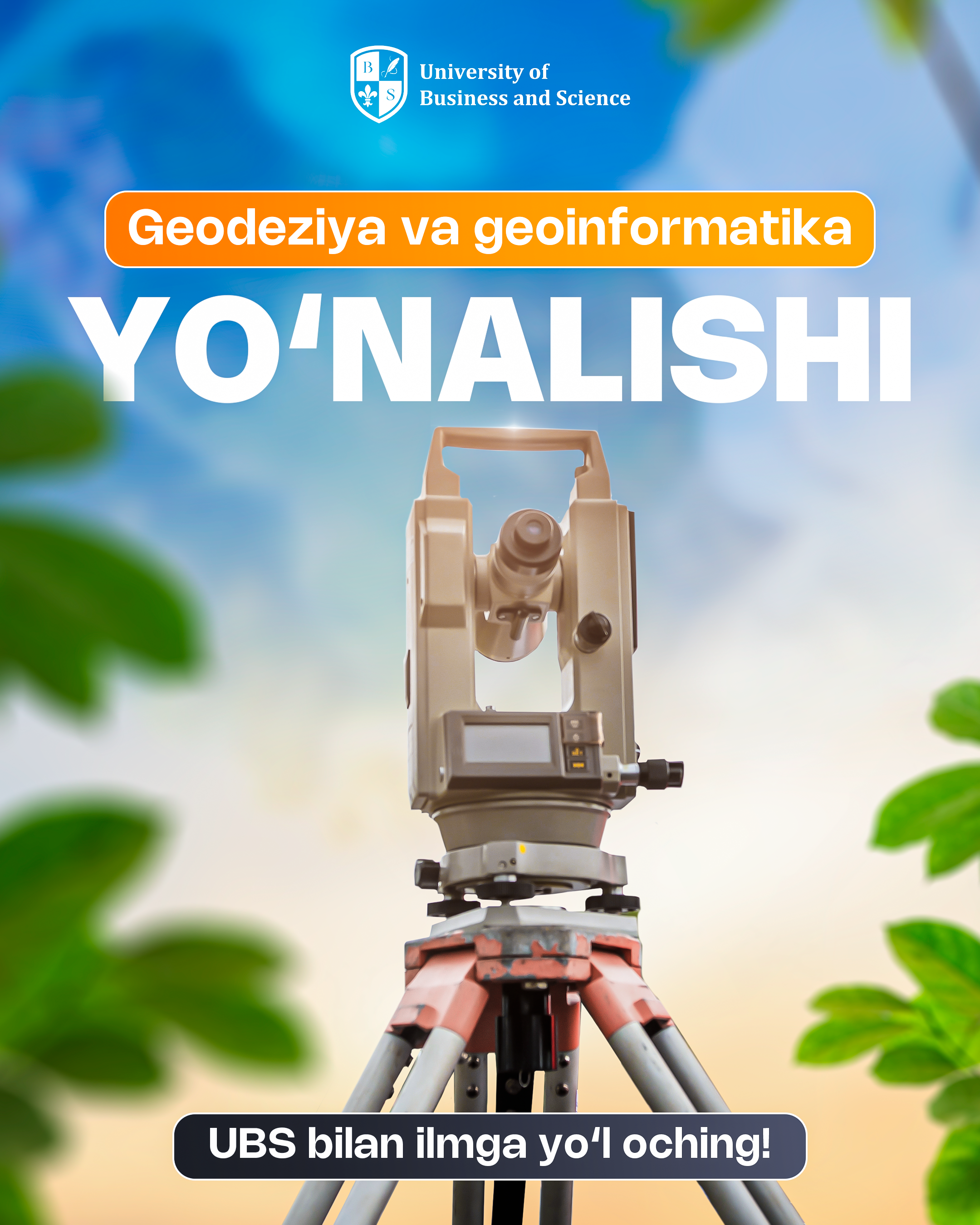
Study mode | Duration | Tuition fees (yearly) |
|---|---|---|
Full time | 4 years | 16,500,000 soum |
General information about the program
Geodesy and geoinformatics are fields related to studying and mapping the Earth, focusing on determining and analyzing the shape, dimensions, and other characteristics of the Earth's surface. Let's take a closer look at each:
Geodesy
Geodesy is the scientific discipline that deals with the measurement and representation of the Earth, including its gravitational field, in three-dimensional, time-varying space. The main tasks of geodesy include:
- Determining the Earth's shape and size: This involves identifying the geoid shape, ellipsoid models, and the elevations of various points on the Earth's surface.
- Creating and maintaining geodetic coordinate systems: These systems ensure the precise location of points on the Earth's surface.
- Studying the gravitational field: Knowledge of the Earth's gravitational field helps understand its internal structure, water reservoirs, and other geophysical processes.
- Measuring distances and directions: This process uses precise measuring instruments and technologies.
Geoinformatics
Geoinformatics involves the collection, storage, analysis, and visualization of geographic information using information technology. The primary tasks of geoinformatics include:
- Geographic Information Systems (GIS): GIS integrates and analyzes various types of data, providing tools for cartography, remote sensing, and other geographic analyses.
- Remote sensing: This technology analyzes data obtained from satellites or airborne devices to monitor the condition and changes of the Earth's surface.
- Data integration and analysis: Geoinformatics combines data from various types and sources to achieve different analytical results.
- Cartography and data visualization: Various technologies are used to visualize geographic information and create maps.
Working in these fields requires deep knowledge of mathematics, physics, computer science, and other technical disciplines. Additionally, familiarity with modern measurement and analysis tools is essential.
Areas where you can work after completing this program:
Land Surveyor: Working on boundary and land surveys, topographic mapping, and construction staking.
Cartographer: Creating maps and spatial data visualizations for various applications.
Remote Sensing Analyst: Analyzing satellite or aerial imagery for environmental monitoring, agriculture, forestry, and urban planning.
Image Processing Specialist: Developing algorithms and techniques for processing and interpreting remote sensing data.
GIS Specialist/Analyst: Managing and analyzing spatial data for urban planning, transportation, environmental management, and emergency response.
GIS Developer: Creating and maintaining GIS software applications and tools.
Environmental Consultant: Using geospatial data to assess and manage natural resources, conduct environmental impact assessments, and develop conservation strategies.
Natural Resource Manager: Overseeing the sustainable management of land, water, and other natural resources.
Urban Planner: Utilizing geospatial data to plan and develop urban and rural areas, including infrastructure, zoning, and land use.
Transportation Planner: Analyzing transportation networks and planning for efficient movement of people and goods.
Geodetic Engineer: Working on large-scale infrastructure projects, ensuring precise measurements and alignment.
Construction Project Manager: Overseeing the spatial aspects of construction projects, including site surveys and as-built documentation.
Geospatial Intelligence Analyst: Working with defense and intelligence agencies to analyze geospatial data for national security and strategic planning.
Cadastral Officer: Managing land records, property boundaries, and legal land ownership documentation.
Research Scientist: Conducting research in geodesy, geoinformatics, remote sensing, and related fields.
University Lecturer/Professor: Teaching and mentoring students in geodesy, geoinformatics, GIS, and related disciplines.
Data Scientist: Utilizing geospatial data for big data analytics, machine learning, and artificial intelligence applications.
Spatial Data Consultant: Providing expertise to businesses on how to leverage geospatial data for decision-making and strategic planning.
Disaster Response Coordinator: Using geospatial data to plan for and respond to natural disasters, including floods, earthquakes, and hurricanes.
Risk Analyst: Assessing and mitigating risks using geospatial information to ensure public safety and preparedness.
If you have any questions, please leave them

Contact us